
LumiNet: An organic illumination network
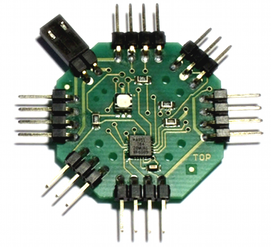
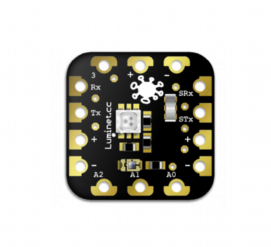
LumiNet is a network of low-cost intelligent pixels that are connected in an organic fashion: Without a central point of control, each node only knows about its immediate neighbors, allowing for highly parallel, fault-tolerant networks in which information spreads from node to node.Each node consists of an RGB LED, microcontroller, and connectors to its neighbors. Sensors attached to nodes may inject stimuli into the network.
New behaviors are injected into the network from a single vector node attached anywhere in the network, in a viral fashion we dubbed "programming by infection".
LumiNet nodes can be used in academia to teach concepts ranging from simple tree algorithms, to wave equations, to swarming behavior, but they are also designed to easily create wearable light-up body networks. Multiple people wearing LumiNets can connect over the air using Send/Receive nodes.
Jan Borchers - idea, hardware board design
René Bohne - programming by infection code
Gero Herkenrath - IR Send/Receive nodes
Ina Rixen - clothes design and sewing
2008-02-05: Initial design concept (jb)
2008-02-20: First working prototype implementation on microcontroller (jb)
2008-03-02: First SMD prototype (jb)
2008-05-31: Bidirectional topology redesign (jb)
2008-08-20: Hardware and software for two interactive jackets complete
| LumiNet_Jacket |
| LumiNet_Node |
2008-08: Wearable LumiNet demo video (jb)
2009-05-19: Binaries of the IDE are available now: Arduino LumiNet IDE for Windows, Arduino LumiNet IDE for Mac OS X --old!! See below for latest version!(rb)
2009-05-20: Detailed software documentation: René Bohne's Master's thesis on LumiNet - check the appendix (rb)
2009-06: It is now possible to use ATtiny2313 microcontrollers with the modified Arduino IDE. Download the ATtiny2313 Arduino core with interrupt support (rb) Important: this core is not compatible to Arduino0018. Please rename the file main.cxx to main.cpp and add this line to the beginning of the file:
#include <WProgram.h>
2009-07-17: Sketching In Hardware presentation about LumiNet (jb)
2009-07-19: LumiNet tutorial for Sketching'09 (jb)
2009-09-03: Video showing two LumiNet jackets communicating (see beginning and end of video) - WDR Lokalzeit report on Dorkbot opening
2009-11-08: Article about sketching in hardware 2009 by Fabricio Dore (rb)
2010-01-17: LumiNet Pin Mapping (rb)
2010-01-30: LumiNet was mentioned in this thesis by Alicia Gibb (rb)
2010-03-11: LumiNet will be in NYC at March 27th! Save the date: http://www.nycresistor.com/2010/03/10/save-the-date/ (rb)
2010-04-22: Young girls used LumiNet on their own individual t-shirt designs at Girl's Day 2010 (rb)
2010-08-23: alpha version of Arduino 0019 with LumiNet support: Arduino LumiNet IDE for Mac OS X (rb)
2010-10-29: What others say about LumiNet:
- http://www.talk2myshirt.com/blog/archives/4719
- http://www.globalpost.com/webblog/technology/luminet-the-wearable-computing-network
- http://www.gearfuse.com/luminet-the-wearable-computing-network/
- http://www.tomsguide.com/us/luminet-jacket-wearable-computer,news-8524.html
- http://blog.littlebirdelectronics.com/luminet-module-you-too-can-look-like-an-attra (rb)
2011-07-01: experiments with new materials... a quick prototype for a textile touch sensor was created.
Examples
Lilith created a bracelet with one LumiNet node and eight LEDs. She shewed everything to fabric and used conductive thread for the electrical connections. Each single LED uses a dedicated LumiNet Pin, so the bracelet can generate different blinking patterns.

Internal project pages (restricted access).
Created by borchers. Last Modification: Friday 18 of November, 2011 22:21:23 by borchers.