The Sound of Juggling
We would like to propose the creation of a computational instrument that
is not only able to act as a frontend to any possible instrument, but also
provides the observer with a pleasing visual presentation.
Sound Creation
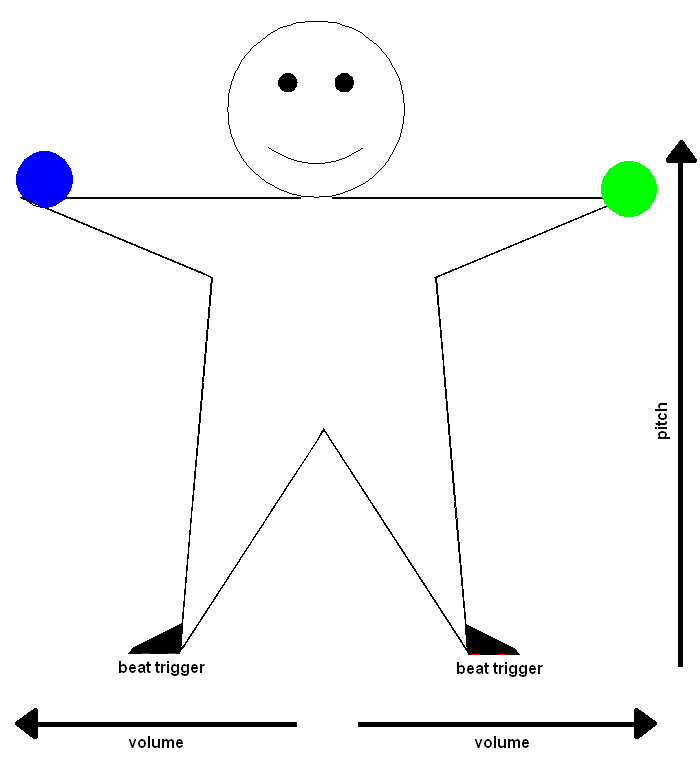
The users will have coloured objects in their hands, whereas each colour
is mapped to a particular instrument.
Moving those objects around, the user can create a ``Music Context" which
can be compared to the graphics context
that OpenGL and similar systems use. The absolute positions of the objects
are captured by a camera. In order to trigger output, the users have to step.
Sensors on their shoes recognise the movement and create sound with the
parameters of the Music Context. The sound will be created as MIDI output.
The mapping of beat to steps is very natural, as it is used for dancing.
While dancing, people move their feet over a repetitive pattern which is
constant apart from slight variations.
Mappings
There are three dimensions that have to be taken care of.
First of all, the choice of the instrument needs to be specified.
In our system, we will assign each instrument a fixed colour.
In order to switch to another instrument, the user will have to take another object.
This is an usual action for musicians and thus a natural mapping.
The second point concerns manipulation the pitch.
Sheets have notes with a higher pitch located above those that are lower.
We will map the notes the same way. Holding the object higher will increase the pitch.
Last but not least, we have to do some manipulation of the volume. The volume can
be mapped to the horizontal axis, choosing a centre point at the user's centre. We
will assume that the camera points to the middle of the user's body.
Applications
There are several ways of using our system. The first might yield the answer to
a question that is at least as important as the one of life, the universe, and everything. ;-)
How does juggling sound?
This question which, after "How is the sound of one Hand clapping?", must clearly be the most
asked question in existence, can finally be solved. Each of the balls will be mapped to a certain
instrument and, depending on the required effect, the performer can either lock the trigger
or activate the triggers at different moments providing the audience with an unforgettable
acoustic experience.
Drawing music
A performer can, using objects in each hand, draw the flow of the music into the air while triggering
the instrument with his feet. The audience will not only be able to hear, but to see the movements of
the melody.
Dancing
Dancing is one of most natural things of following the rhythm. In our system, we
turn this relationship around, letting the dancer create the rhythm. The instruments
can be defined by coloured spots on the back of the dancers. Turning around increases the
volume until it suddenly disappears, and bending your knees leads to the typical
beginning of a tango.
Collaborative music-making
If the distance between the camera and the performing stage is great enough, multiple people
can work together in the creation of the music circumventing the natural limitations of
simultaneous instrument per person. The collaboration effect is enhanced due to the mapping of
the volume to the x-axis which forces the performers to switch places or instrument to change the
relative volume of their instruments.
Extensions and Variations
- In addition to these traditional instruments, we could create
special effects instruments that trigger
a sound just by their appearance. (Such as an instrument which, as soon
as it is recognised by the system, will play a telephone-ringing
sample. This could help create stunning visual performances.)
- The system could be set to either translate movements while
triggered to pitchbend or to release the current key and hit the next
one. This would enable the system to more realistically simulate
discrete as well as continuous instruments (violin vs. piano.)